

Artworks for Hotels and Restaurants: What to Get Right Before You Commission
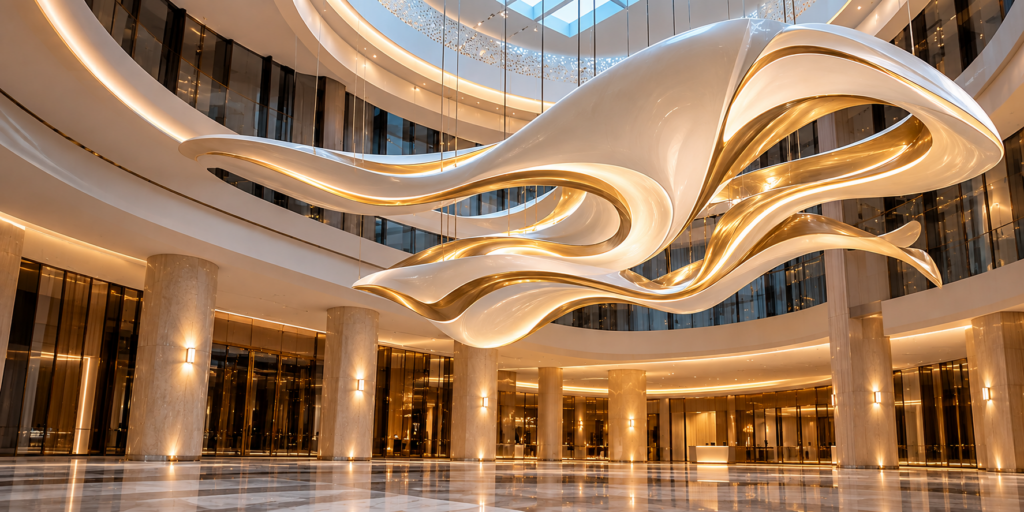
Ask most people what GRP is and you will get an answer about boats. Ask an architect working on a Dubai hotel lobby, and increasingly the answer is a ten metre sculptural feature suspended from a ceiling that could never have carried the same form in bronze.
GRP stands for glass reinforced plastic. FRP, fibre reinforced polymer, is the broader term covering the same principle with other fibres. In architectural work the two labels are often used interchangeably, and both describe a moulded composite: fibre providing tensile strength, resin providing form and surface.
For projects across the UAE and the wider Middle East, the material solves a specific set of problems. It also has limits that are worth stating plainly before anyone commits.
Weight is the reason most projects choose it
The single biggest advantage is mass. A composite element is dramatically lighter than the equivalent form cast in bronze, brass or aluminium, which changes what is possible in three ways.
It changes what can be hung. Ceiling-suspended features, atrium pieces and soffit installations are limited by what the slab and the secondary steelwork will accept. A lighter element widens the range of viable fixing strategies and often removes the need for structural strengthening.
It changes how the piece is installed. Lighter sections can be lifted by a smaller crew with lighter equipment, which matters on a fit-out running to a tight programme in an occupied or partially completed building.
It changes what can be transported. Large forms can be moulded in sections, shipped economically and joined on site.
Complex geometry without the cost of casting it
Composite fabrication is a mould process. Once a mould exists, complex organic curves, undercuts, repeated modules and flowing surfaces cost far less to produce than the equivalent in cast metal, which requires pattern-making, casting, chasing and finishing for each piece.
For designs that rely on repetition, a run of identical elements across a facade or ceiling, the economics improve further, because the mould cost is spread across the run. For one-off sculptural pieces with difficult geometry, the mould is still often cheaper than the casting route.
This is why so much of the free-form, nature-derived work now appearing in Gulf hospitality interiors is composite rather than metal. The form drove the material choice.
Performance in Gulf conditions
The regional climate is a genuine argument for composites. Coastal humidity, airborne salt, intense UV and large surface temperature swings are hard on materials.
Composites do not corrode. There is no rust, no galvanic reaction between dissimilar metals, and no oxidation staining running down an adjacent stone or plaster surface. For coastal projects, poolside installations, and anything near water features, that alone can decide the specification.
UV performance depends on the specification, not the material category. A composite finished with a UV-stable gelcoat or an appropriate topcoat holds colour well in external conditions. A composite finished without that protection will chalk and fade. This is the most common cause of disappointing outdoor composite work in the region, and it is a specification failure rather than a material one.
Fire performance needs to be specified, not assumed
Standard resin systems and fire-rated resin systems are not the same product. Where a composite element forms part of an internal lining, a ceiling, or anything within a means of escape, the fire classification of the finished element matters and will be scrutinised.
Fire-retardant resin systems and appropriate surface classifications are available and widely used on commercial work. The requirement should be established with the project consultant and the authority having jurisdiction at the start of the design, because it affects the resin system, the laminate build-up and the cost, and it cannot be added afterwards.
Where GRP and FRP are the wrong answer
Being straight about the limits protects the design.
Composites are surface materials. A sharp impact at low level can chip or crack a laminate in a way a solid bronze element would shrug off. In high-traffic circulation zones at hand height, that is a real consideration, and metal or a protected detail may serve better.
Repairs are possible and often invisible, but they need a specialist. An operator’s maintenance team cannot patch a gelcoat the way they can polish a scratch out of stainless steel.
The material also carries an association that some clients resist. Where the brief is explicitly about permanence, weight and material honesty, a cast metal piece communicates something a composite does not, whatever the finish. That is a legitimate reason to choose casted metal works instead.
Choosing between composite and metal
The decision usually comes down to four questions. What does the form require? What will the structure accept? What conditions will the piece live in? And what does the client need it to feel like?
Where the form is complex, the fixing capacity is limited, the environment is corrosive, or the piece is large, composites make sense. Where the piece is small, reachable, and the brief is about material weight and permanence, metal usually wins.
At AURRA we fabricate GRP and FRP artworks alongside cast metal, chainlink and glass work, which means the material recommendation is not driven by what we happen to make. Our team works from concept through fabrication, finishing and on-site installation across the UAE and Middle East.
Frequently Asked Questions
What is the difference between GRP and FRP?
GRP refers specifically to glass reinforced plastic. FRP is the wider category of fibre reinforced polymers, which includes glass and other fibres such as carbon or aramid. In architectural and artwork applications the terms are often used to describe the same glass-fibre composite.
Is GRP suitable for outdoor use in the UAE climate?
Yes, when it is specified correctly. The composite itself does not corrode, which suits coastal and humid conditions. Long-term appearance depends on using a UV-stable gelcoat or protective topcoat, without which surfaces will fade and chalk under sustained sun exposure.
How long does a GRP or FRP artwork last?
A correctly specified and properly installed composite element has a long service life in interior conditions, and performs well externally when UV protection is maintained. Lifespan is determined more by the surface system and the installation detail than by the laminate itself.
Can GRP be made to look like bronze or brass?
Yes. Cold-cast metal finishes incorporate real metal powder into the surface layer, which is then polished or patinated. The result is a genuine metal surface on a lightweight composite body, at significantly less weight than a solid casting.
Is GRP fire-rated?
Not by default. Fire-retardant resin systems and appropriate surface classifications are available and routinely used on commercial projects, but the requirement must be confirmed with the project consultant and the relevant authority at design stage, because it affects the build-up of the element.
Recent Post
-
 28 Oct 2026 InteriorChoosing an Ironmongery Supplier in Dubai: 8 Questions
-
28 Oct 2026 InteriorPivot Doors vs Hinged Doors: Which Suits Your Entrance?
-
16 Sep 2026 InteriorGlass and Lighting as Architecture: Specifying With Atelier MEL
-
 10 Sep 2026 Metal ArtBenefits of GRP and FRP in the UAE and Middle East
-
 26 Aug 2026 Metal ArtArtworks for Hotels and Restaurants: What to Get Right Before You Commission
Stay Inspired with Aurra
Join our newsletter for design insights, new collections, and exclusive updates.


