

Artworks for Hotels and Restaurants: What to Get Right Before You Commission
On most hospitality projects, the artwork is the last package specified and the first thing a guest photographs.
That order causes problems. By the time the art scope is defined, the ceiling void is allocated, the lighting layout is fixed and the opening date is non-negotiable. The piece meant to define the lobby ends up sized around whatever space is left.
The bigger issue is that “artwork” gets treated as one decision, when it’s really several. A cast metal feature wall, a chainlink curtain, a suspended glass chandelier and a GRP sculptural form are different disciplines, different lead times and different questions to ask before commissioning, not variations on the same brief.
Artwork is a category, not a material
Four disciplines cover most of what a hospitality project needs, and each has its own logic.
Casted metal works deliver sculptural depth and relief that sheet or fabricated metal can’t achieve, feature walls, murals and hero pieces where the brief calls for real dimension rather than a printed or laminated finish. The trade-off is weight: cast pieces need structural sign-off before design is finalised, not after.
Chainlink artworks, made with Kriskadecor, use individually finished aluminium links to build curtains, partitions and ceiling features that filter light and sightlines rather than closing a space off. Lightweight enough to hang across large spans, and the reason they show up so often in hotel lobbies and restaurant partitions where a solid divider would feel heavy.
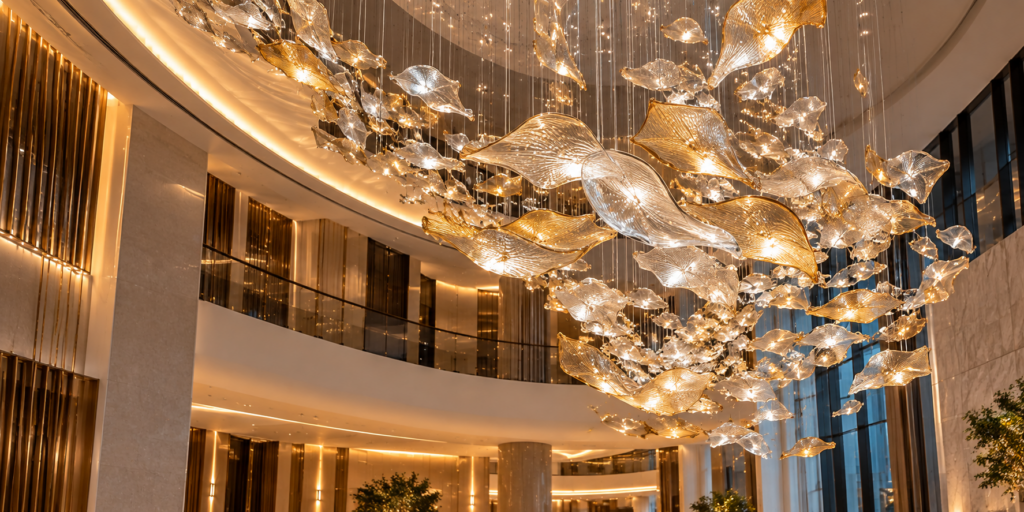
Glass, lighting and special installations, delivered through Aurra’s partnership with Atelier MEL, cover chandeliers, glass wall art and lighting-integrated pieces engineered for architectural spaces rather than adapted from a catalogue fixture. This is the discipline where the artwork is the lighting, not a separate layer applied to it.
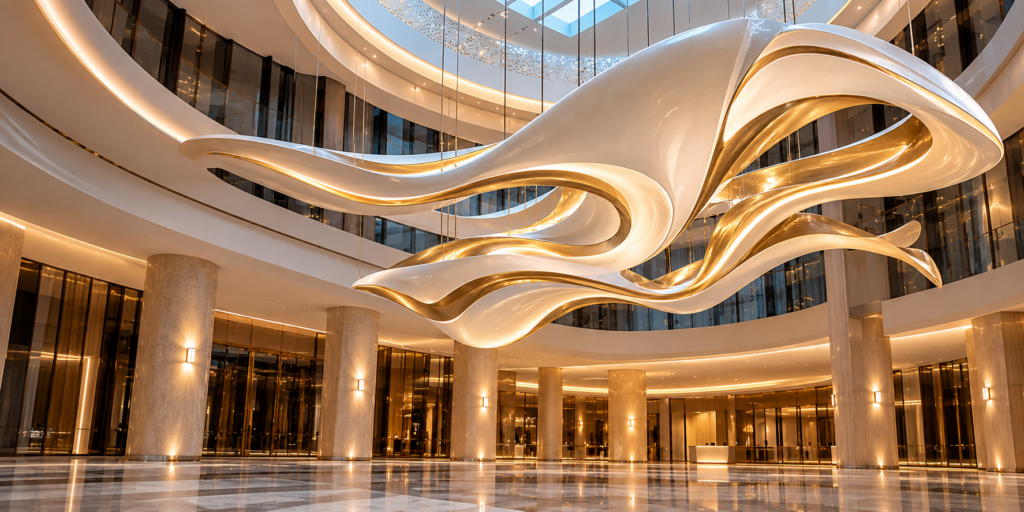
GRP/FRP artworks achieve complex sculptural geometry at a fraction of the weight of cast metal: the answer when the design is ambitious but the structure won’t take the load.
Most hospitality projects end up using more than one of these across a single property. A lobby chandelier, a restaurant chainlink screen and a cast metal reception feature are three different commissions running in parallel, not one artwork scaled across three rooms.
Where hospitality artwork usually goes wrong
The failure points differ by discipline, but they share a root cause: each one gets treated as a finishes item rather than a coordinated building element, and enters the programme after the decisions that constrain it are already made.
Cast and chainlink: commissioned after the ceiling closes
A suspended or wall-mounted piece needs a structural connection, a route through the ceiling build-up, and maintenance access. Deciding all three after MEP coordination has closed leaves two options: a compromised fixing, or a redesigned piece.
Lighting and glass: designed after the layout is fixed
Where light is integral to the piece rather than added afterward, the installation has to be part of the electrical and structural planning from the start. Lamp access, load points and colour temperature aren’t finishing touches, they’re design inputs. Atelier MEL’s own process runs concept alignment and technical detailing before fabrication starts, which only works if that conversation happens early enough to still shape the ceiling and services layout, not after it’s locked.
Finish chosen for the render, not the room
A mirror-polished panel looks extraordinary in a visual and shows every fingerprint in a working space. The lower 1.5 metres of any installation lives a different life to the part above it, and is rarely specified that way.
None of these are fabrication problems. They’re coordination problems, and all of them are cheaper to solve at design stage than at snagging.
Matching discipline to the zone
Zone | Conditions | Generally suits |
Lobby and atrium | High footfall, dramatic lighting, contact at hand height | Cast metal, chainlink, statement lighting |
Restaurants and bars | Warm light, close viewing distance, grease and steam near open kitchens | Chainlink screens, brass and bronze finishes, backlit glass |
Pool, spa and wet areas | UV, chlorine, humidity, salt air on coastal sites | 316 stainless cast work, treated aluminium chainlink, GRP/FRP |
Guest corridors | Trolley strikes, repeated cleaning, low light levels | Durable textured finishes, recessed or protected installations |
What to check before you commission
For cast metal and chainlink: confirm structural capacity and fixing detail with your engineer before design is finalised. Cast work carries real weight; chainlink is light but still needs a confirmed load point and a fixing detail signed off in writing, not assumed from a supplier datasheet.
For glass, lighting and special installations: treat concept alignment and technical detailing as design-stage work, not a task for the fit-out contractor to solve later. Confirm lamp replacement access, colour temperature, and structural load in the same conversation as the ceiling and services layout, not after it’s built.
For GRP/FRP: confirm the geometry the structure can actually support before the concept is finalised. GRP/FRP exists precisely to make ambitious forms possible on structures that couldn’t carry them in metal, so use that headroom deliberately rather than defaulting to it after a cast concept gets rejected on weight.
Across all of them: sample and mock-up approval before ordering. None of these finishes can be signed off from a printed image. A physical sample under the specified lighting is the only reliable check, and it’s far cheaper to reject at sample stage than after fabrication.
Specifying artwork for UAE hospitality projects
The difference between artwork that works and artwork that becomes a snagging item is rarely the design. It’s whether discipline, fixing, structure, lighting and approvals were resolved as one decision each, not five variations on the same conversation.
Aurra works with architects, interior designers and fit-out contractors across the UAE on bespoke artwork spanning cast metal, chainlink installations with Kriskadecor, glass and lighting with Atelier MEL, and GRP/FRP sculptural work. Because we’re not tied to one discipline or one workshop, the recommendation follows the space rather than the stock list.
If you have a hospitality project in design, talk to our team while the concept is still flexible.
Frequently Asked Questions
What type of artwork suits a hotel lobby best?
It depends on what the lobby needs to do. Cast metal and lighting-integrated glass pieces work well as a single hero moment; chainlink suits spaces that need separation without closing the room off. Most lobbies end up combining more than one.
How far in advance should hospitality artwork be commissioned?
Earlier than most programmes allow. The critical path is design development, sampling, approvals and structural or technical coordination, not fabrication. Bringing the specialist in during design development, not at tender, prevents most of the changes that extend delivery.
Can chainlink and cast metal be used in the same space?
Yes, and it’s common in hospitality, a cast metal feature wall paired with a chainlink partition or ceiling feature, for instance. Each is specified and fixed independently, so combining them is a design decision, not a technical constraint.
Recent Post
-
 16 Sep 2026 InteriorGlass and Lighting as Architecture: Specifying With Atelier MEL
 -
 10 Sep 2026 Metal ArtBenefits of GRP and FRP in the UAE and Middle East
 -
 26 Aug 2026 Metal ArtArtworks for Hotels and Restaurants: What to Get Right Before You Commission
 -
 26 Aug 2026 Metal ArtHow to Maintain Ironmongery in the UAE for Longevity
 -
 26 Aug 2026 Metal ArtTop 10 Benefits of Glass in Modern Architecture
Stay Inspired with Aurra
Join our newsletter for design insights, new collections, and exclusive updates.


