

Top 10 Benefits of Glass in Modern Architecture
Ask an architect what glass does in a building and most will start with the facade: light, transparency, energy performance. That’s true, and it’s also only half the story. The same material, worked differently, becomes something else entirely: a sculptural medium capable of holding light, colour and form in ways few other materials can match.
That’s the territory this piece covers. Not structural glazing, but glass as architectural art, chandeliers, wall installations, and lighting-integrated pieces designed to be the feature, not the frame around one.
1. Light behaves like nothing else does
Glass doesn’t just let light through, it bends, scatters and refracts it, changing appearance through the day and under different artificial lighting. A glass installation photographs differently at 6pm than at midnight, which is exactly why it earns its place as a lobby or atrium centrepiece rather than a fixed, flat feature.
2. It carries colour without needing paint or coating
Colour built into glass itself, through the material and the casting or fusing process, reads with a depth that applied finishes can’t replicate. Where a painted surface reflects light, coloured glass transmits and refracts it, giving the colour a dimensionality that shifts with the viewer’s position.
3. It scales from a single pendant to a full ceiling feature
The same underlying craft, working glass into custom forms, applies whether the brief is one chandelier or a full-ceiling installation across a hotel atrium. That range makes it one of the few art mediums equally suited to an intimate restaurant nook and a large-scale public space.
4. Engineering precision means ambitious forms are achievable
Modern glass art isn’t limited to traditional blown or cut forms. Working at the intersection of artistry and digital design technology, as Atelier MEL does, allows complex geometric and organic forms to be engineered and fabricated with a level of precision that pure handcraft alone can’t guarantee at scale.
5. It pairs naturally with lighting, because it often is the lighting
Where a sculptural piece needs a separate lighting plan, glass frequently doesn’t, because the light source is integrated into the piece itself. That collapses two design decisions into one, and avoids the common failure of artwork and lighting being specified by different people who never spoke to each other.
6. It suits hospitality's need for a photographable moment
Hotels and restaurants increasingly design for the photograph a guest will take, not just the space they’ll occupy. A statement glass chandelier or wall feature gives a lobby or dining room a focal point built for exactly that, in a way a flat wall finish rarely does.
7. It works across a wide range of settings
Glass art installations suit hospitality, residential, retail and public spaces without needing a different design language for each. A vertical chandelier that anchors a hotel stairwell and a glass wall mosaic in a private residence draw on the same underlying craft, adapted to scale and setting.
8. Custom fabrication means no two projects compete for attention
Because each piece is designed and fabricated to the project rather than selected from a catalogue, a glass installation doesn’t risk turning up in a competitor’s lobby six months later. For hospitality brands especially, that originality is part of what justifies the commission.
9. It bridges art and engineering rather than sitting purely in one camp
A cast metal sculpture is primarily a design and fabrication exercise. A glass installation, particularly anything suspended or lighting-integrated, is also a structural and electrical one. Getting that engineering right from the concept stage is what separates a piece that still looks intentional in five years from one that becomes a maintenance problem.
10. It ages differently to painted or printed finishes
Glass doesn’t fade, chip or need repainting the way many surface finishes eventually do. A well-specified glass installation, properly fixed and maintained, holds its visual quality over time in a way that lower-cost decorative alternatives generally don’t.
Specifying glass art for a UAE project
The question isn’t whether glass belongs in a modern building, most projects already answer that at facade stage. It’s whether the same material is being used to its full potential as a design element, not just a functional one.
Aurra delivers custom glass installations and architectural lighting through its partnership with Atelier MEL, a Spain-based studio working at the intersection of artistry and digital design technology. Because the work is engineered and fabricated to each project rather than selected from a range, the result follows the space rather than a catalogue.
If you have a lobby, stairwell or feature space in design, talk to our team about what a glass installation could do for it.
Frequently Asked Questions
Is glass art durable enough for high-traffic hospitality spaces?
Yes, when engineered correctly. The fixing and structural detail matter more than the material itself, since properly specified glass installations are built to withstand the loads and traffic of public spaces.
How is a custom glass chandelier different from a catalogue fixture?
A custom piece is designed and engineered to the specific space, scale and lighting requirements of the project, rather than adapted from a standard product. That generally means better integration with the ceiling and services layout, and a result that isn’t duplicated elsewhere.
Can glass installations work outside hospitality settings?
Yes. Residential feature lighting, retail entrances and public spaces all use the same underlying craft, scaled and adapted to the setting.
Recent Post
-
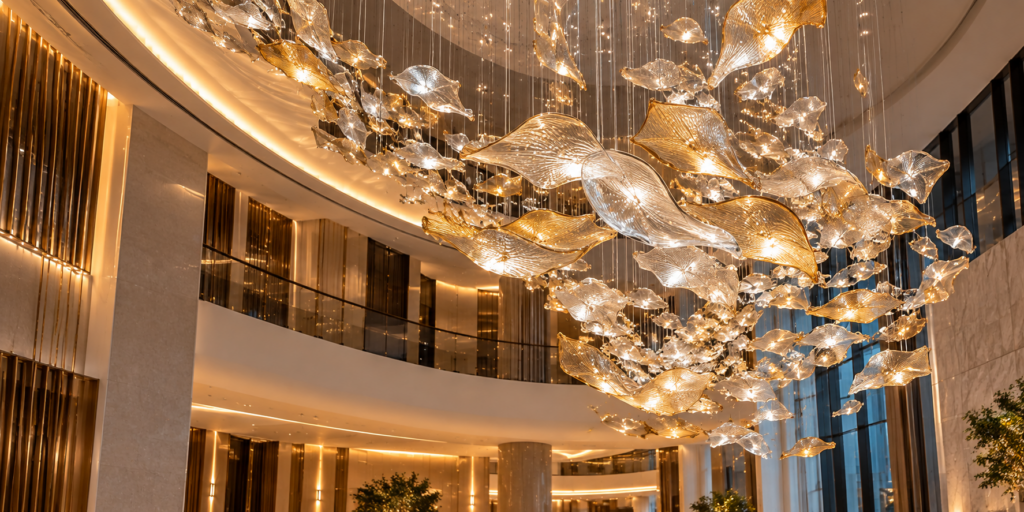 16 Sep 2026 InteriorGlass and Lighting as Architecture: Specifying With Atelier MEL
 -
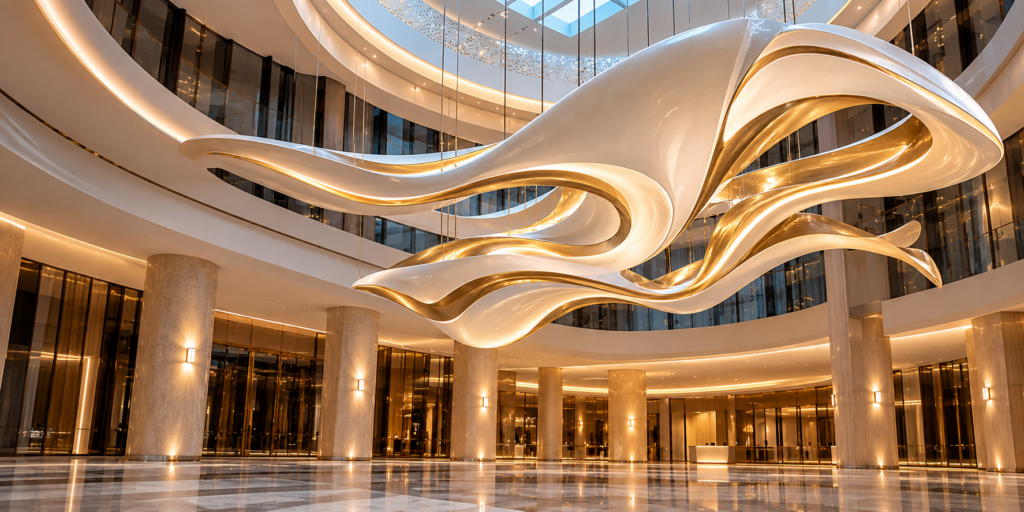 10 Sep 2026 Metal ArtBenefits of GRP and FRP in the UAE and Middle East
 -
 26 Aug 2026 Metal ArtArtworks for Hotels and Restaurants: What to Get Right Before You Commission
 -
 26 Aug 2026 Metal ArtHow to Maintain Ironmongery in the UAE for Longevity
 -
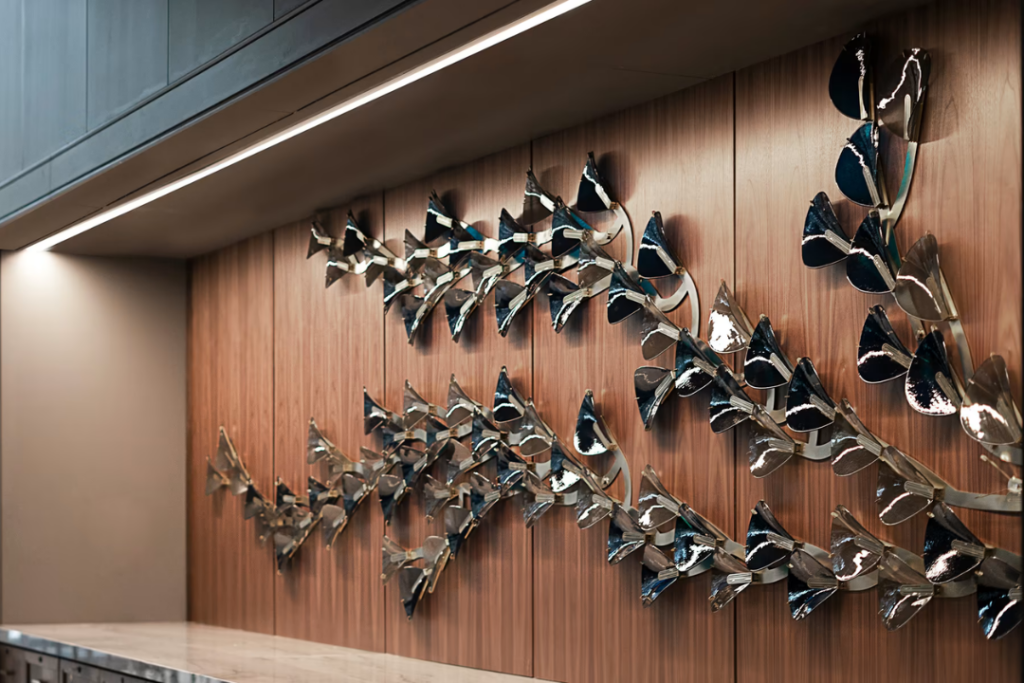 26 Aug 2026 Metal ArtTop 10 Benefits of Glass in Modern Architecture
Stay Inspired with Aurra
Join our newsletter for design insights, new collections, and exclusive updates.


