

Why Architectural Ironmongery Matters in Modern Design
Ironmongery is the part of a building people touch most and specify last.
That sequence is the whole problem. By the time the schedule is written, door thicknesses are fixed, frames are ordered, the fire strategy is issued and the finishes palette is locked. Hardware then gets selected against whatever remains, usually under time pressure and often from a catalogue.
The result is rarely dramatic. It is a lever that feels cheap on an otherwise considered door, a closer that fights people in a stairwell, a finish that does not match the one three metres away, or a fire door set that cannot be signed off because one component has no certificate. None of those are design failures. They are specification failures.
A door is a system, not a shopping list
A single commercial door might carry hinges from one manufacturer, a lock case from another, a cylinder from a third, a lever from a fourth, a closer from a fifth, and seals from a sixth.
Those components have to work as one assembly. They share tolerances, they share a door leaf, and on a fire door they share a certificate. Change one and the others are affected.
A heavier lever changes the load on the hinge. A concealed hinge or pivot system changes the door’s swing geometry, which changes where the closer arm can sit. A higher-security cylinder can change the backset, which changes the lock case that fits, which changes which handle plates will cover the preparation cleanly.
This is why ironmongery specified item by item, from separate sources, tends to produce doors that contain everything on the list and still do not work properly.
The schedule is the actual deliverable
On a project of any size, the ironmongery schedule is where the thinking lives. Not the product images. The schedule.
A good one records, door by door: function, fire rating, security and accessibility requirements, handing, frame type, leaf thickness, and every component with its finish. It is what lets a contractor order correctly, a carpenter prepare correctly, and an inspector verify correctly.
A weak schedule loses money in three predictable ways. Doors that were never properly surveyed, so handing errors surface during installation as a site problem rather than a drawing problem. Function assigned by room name rather than by use, when a store room and a plant room need entirely different hardware, as do two doors labelled “corridor” when one is on an escape route. And no finish column, because finishes agreed verbally do not survive procurement.
Getting this right takes someone who has assembled doors before, not just selected products. That is the substance of an ironmongery consultation: reviewing the drawings, resolving function door by door, and producing a schedule that survives contact with site.
Where the UAE changes the answer
Most published guidance on ironmongery is written for temperate climates. Gulf conditions change several assumptions.
Condition | Practical response |
Sustained high temperature | Check hand contact temperature on sun-exposed entrances, and confirm closers are rated for the range. |
Airborne dust and sand | Specify cylinders, tracks and closers that tolerate particulate ingress, with a realistic maintenance interval. |
Coastal salt air and UV | Grade 316 stainless and PVD finishes on external doors, rather than 304 and decorative plating. |
Tall buildings | Coordinate closer selection with the fire and mechanical strategy, since stairwell pressure differentials affect closing force. |
None of these are exotic requirements. They are ordinary conditions that a specification written for a different climate will not account for.
Compliance is an assembly question
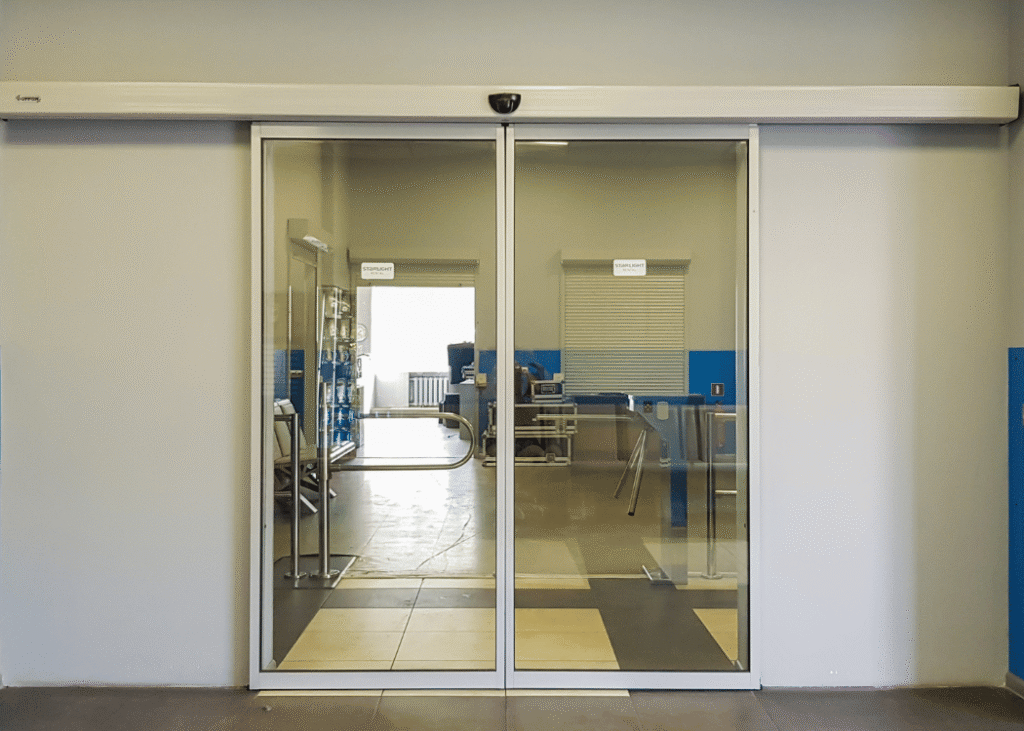
Behind either door type, the door automation systems motors, sensors, safety beams, and control logic are what actually determine reliability
This is where ironmongery stops being a finishes decision.
Fire doors are certified as complete assemblies, tested with a specific combination of leaf, frame, hinges, lock, closer and seals. Substituting one component can invalidate the certification for the whole set, however similar the replacement looks.
Escape doors are governed by function rather than preference. Panic hardware to EN 1125 is intended where occupants are unfamiliar with the building, such as public and assembly areas. Emergency exit hardware to EN 179 suits buildings where occupants know the exits. That choice is a life safety decision, so the exit device specification should follow the fire strategy rather than the finishes palette.
In the UAE all of this sits under the UAE Fire and Life Safety Code of Practice enforced by Civil Defence, and authorities expect traceable, certified hardware as part of the tested doorset. The documentation needs to exist before material reaches site, which makes sourcing part of the compliance question. Aurra supplies through direct manufacturer relationships so that certification and warranty arrive with the product.
over years of use, not the door leaf itself. This is where automation quality differs most: sensor sensitivity, obstacle detection, and how the system behaves during a fire alarm or power failure. Specifying automation separately from the door leaf, rather than treating it as a single bundled product, gives a project the flexibility to match automation quality to how heavily a given entrance will actually be used day to day, and to service or replace the mechanism later without redesigning the whole entrance.
Finish is where coordination usually breaks
Modern interiors have pushed hardware away from satin chrome and into brass, bronze, blackened steel and custom PVD tones. That is a design gain and a coordination burden.
A hinge, a lever and a closer from three different factories, all nominally in the same brass, will rarely match exactly, because different substrates and processes produce different results. Where an exact match matters, either source the visible components from one manufacturer or design in a deliberate contrast rather than a near-miss.
Living finishes need the same care. Unlacquered brass and bronze patinate, which is the point of specifying them, but it has to be agreed with the client and facilities team in writing before handover. Otherwise the intended patina becomes a defect report in month four.
Specifying architectural ironmongery on UAE projects
Nobody walks into a building and admires the hinges. But people notice a door that binds, a handle that feels wrong in the hand, a closer that slams, and a finish that does not match the one beside it.
The single change that improves outcomes more than any other is involving someone with hardware knowledge during design development rather than at tender. Early input resolves door thickness and frame details before they are fixed, catches fire and function requirements while they can still be drawn rather than corrected, and identifies long lead items before they reach critical path.
Aurra works with architects, interior designers and contractors across the UAE on ironmongery specification and supply, from schedules and consultation through to certified product sourced directly from European manufacturers.
If you have a project in design, talk to our team before the schedule is issued.
Frequently Asked Questions
What is architectural ironmongery?
Architectural ironmongery covers the hardware that makes a building’s doors, windows and joinery function: hinges and pivots, locks and cylinders, levers and pull handles, closers and floor springs, exit devices and seals. It spans engineering performance, code compliance and design, which is why it is specified rather than simply purchased.
What is an ironmongery schedule and why does it matter?
An ironmongery schedule lists every door on a project with its function, fire and security requirements, handing, and each hardware component with its finish. It allows accurate ordering, correct door preparation and straightforward verification at inspection. On a large project it is the single most important ironmongery document.
Can hardware components be substituted on a fire door?
Not freely. Fire doors are certified as complete tested assemblies, so substituting a component can invalidate the certification for the whole set even where the replacement appears equivalent. Any change should be checked against the certification before it is made.
Which hardware finishes work best in UAE conditions?
For external and coastal positions, grade 316 stainless and PVD-coated finishes generally outperform decorative plating, because of salt air, UV and dust. Interior positions have far more latitude, though living finishes such as unlacquered brass should be agreed with the client and facilities team before handover.
What is the difference between EN 1125 and EN 179 hardware?
EN 1125 panic hardware is intended for buildings where occupants may be unfamiliar with the exits, such as public and assembly spaces. EN 179 emergency exit hardware suits buildings where occupants know the building. The choice follows the fire strategy and occupancy, not design preference.
Recent Post
-
 26 Aug 2026 Metal ArtArtworks for Hotels and Restaurants: What to Get Right Before You Commission
 -
 26 Aug 2026 Metal ArtHow to Maintain Ironmongery in the UAE for Longevity
 -
 26 Aug 2026 Metal ArtTop 10 Benefits of Glass in Modern Architecture
 -
 25 Aug 2026 Metal ArtWhy Architectural Ironmongery Matters in Modern Design
 -
 23 Jul 2026 Metal ArtAutomatic Sliding & Swing Door Systems for Commercial and Hospitality Entrances
Stay Inspired with Aurra
Join our newsletter for design insights, new collections, and exclusive updates.


